
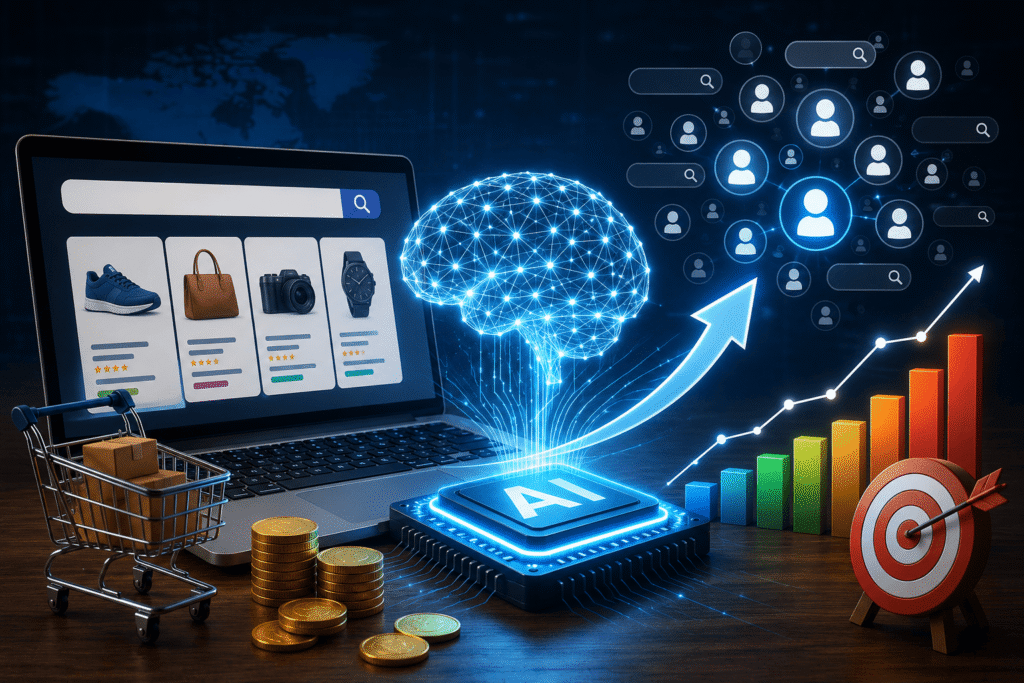
Nobody searches like they used to. A few years back, you’d type “office chair” and scroll through the results. Now people type entire sentences into that search bar like they’re texting a mate who works in furniture. “Comfortable office chair for long workdays that won’t wreck my back.” “Best laptop for architecture students under $2,000.” Full sentences, real questions, genuine buying intent baked right in.
The problem for advertisers is that most of those searches never matched their keyword lists. Someone’s clearly ready to buy, and the ad account has no idea they even exist.
That’s the gap Google’s trying to close with AI Max for Search campaigns. Google’s own claim is that this update opens up billions of new monetisable searches, not by inventing new queries out of thin air, but by finally understanding what people mean when they type something that doesn’t look like a neat little keyword.
For anyone running performance marketing, this isn’t just another feature buried in an update log. It’s a genuinely different way of thinking about who you’re trying to reach. And if your business depends on PPC services or pay per click advertising, ignoring this shift means watching competitors scoop up traffic you never even knew was there.
What Is Google AI Max?
AI Max is a new layer on top of Search campaigns designed to get your ads in front of more relevant searches without you having to guess every possible keyword variation in advance.
The old question was always “did the user type this exact keyword?” Google’s shifted that to something closer to “is this what the person’s looking for?”
In practical terms, AI Max can:
- Read the intent behind long, conversational searches
- Match your ads to commercial searches that never showed up on a traditional keyword list
- Pull together headlines and descriptions from the assets already sitting in your account
- Send someone to whichever page on your site best answers their search, instead of forcing everyone through one fixed URL
- Surface search opportunities you probably hadn’t thought to target
None of this replaces keyword targeting. It just widens the net, so your campaign can pick up searches that would’ve slipped straight past it before.
What Does “Billions of New Monetisable Searches” Really Mean?
That headline number’s grabbed a lot of attention, and it’s worth slowing down to unpack it.
Google isn’t claiming billions of brand-new searches materialised overnight. What’s changed is Google’s ability to recognise commercial intent in searches that don’t look like typical keyword queries, which means advertisers can now show up for searches that were always happening, just always slipping through the cracks.
A few examples of what that looks like in the wild:
- “Which standing desk is best for a small apartment?”
- “Affordable bookkeeping software for new cafés.”
- “Energy-efficient outdoor lights for coastal homes.”
None of these read like a keyword you’d bid on in 2019. All of them are someone doing genuine research before they hand over money.
For businesses, that translates to:
- Getting in front of customers earlier, while they’re still comparing options
- Better visibility on the oddly specific searches nobody thought to target
- Less time spent building out endless keyword lists
- A shot at qualified traffic that was previously invisible to the account
Traditional Search Campaigns vs AI Max
| Traditional Search Campaigns | AI Max Search Campaigns |
| Leans almost entirely on keyword matching | Focuses on what the person wants |
| Someone has to manually keep expanding the keyword list | Finds extra relevant searches on its own |
| Traffic usually funnels to one set landing page | Picks whichever landing page fits the query best |
| New ad variations mean more manual work | Can generate extra assets to sharpen relevance |
What This Means for Performance Marketing
Good performance marketing has always come down to one thing: putting your business in front of people who are ready to act. AI Max just hands advertisers a wider net to do that with.
But it also raises the bar a bit.
If your site’s slow to load, your landing pages don’t answer the question someone typed, or your conversion tracking’s been broken for three months, and nobody noticed, more visibility isn’t going to save you. It just means more people bouncing off a page that wasn’t ready for them.
Worth focusing on instead:
- Reviewing your campaign structure instead of leaving it on autopilot
- Building landing pages that match what people are searching for, not just what you want to sell them
- Making sure conversion tracking is set up properly and stays that way
- Testing different ad creative rather than running the same three lines for a year
- Working with PPC services providers who keep optimising campaigns instead of setting them up once and walking away
The businesses treating pay per click advertising as something you keep tuning, rather than something you set and forget, are the ones who’ll feel the benefit of this update.
Why Google Shopping Ads Could Benefit Too
Retailers stand to gain a fair bit here too.
A lot of shoppers don’t start with a brand name in mind. They start with a question, something like “which running shoes are best for flat feet,” long before they’ve settled on who they’re buying from. Because AI Max is better at picking up on that kind of intent, Google Shopping Ads may start showing up for a wider range of these detailed, comparison-style searches.
To actually make the most of that, retailers should be checking that:
- Product titles are genuinely descriptive, not just a SKU number
- Product feeds are accurate and not months out of date
- Images are decent quality, not a stretched thumbnail from 2019
- Pricing and stock levels are current
- Landing pages give people the full picture, not just a product name and a buy button
These sound like small things. They’re usually what separates the products that win the click from the ones that get scrolled past.
What Should Businesses Do Next?
None of this is about throwing keywords out the window. It’s about building campaigns that reflect how people search now, rather than how they searched five years ago.
A few practical starting points:
- Go through your existing Search campaigns and look for the obvious gaps in keyword coverage
- Strengthen your website content so landing pages genuinely answer what people are asking
- Keep product information current, especially anything tied to Google Shopping Ads
- Check in on campaign performance and search terms regularly, not once a quarter
- Keep refining your performance marketing strategy based on what’s converting, not just what’s getting clicks
Businesses that get onto this early will have a real head start as search behaviour keeps shifting.
Conclusion
Google AI Max is another step toward advertising that follows intent rather than exact wording. By helping advertisers reach commercial searches that traditional keyword targeting would’ve missed, it opens up genuine opportunities to connect with people at the moment they’re ready to buy.
That said, the technology only does part of the job. Strong strategy, relevant content, and ongoing optimisation still matter just as much as they always have. Businesses that pair those fundamentals with properly managed PPC services are the ones who’ll turn this extra visibility into results they can measure.
Grow Smarter with Techosoft
Google Ads doesn’t sit still, and keeping up with every change isn’t a small job. At Techosoft Solutions, we build performance marketing strategies around real data, aimed at helping businesses get more out of every dollar spent. Whether that’s managing PPC services, fine-tuning Google Shopping Ads, or refining pay per click advertising campaigns, our focus stays on results you can point to, not just numbers that look good in a report.
Get in touch with our team today to discover how your Google Ads campaigns can stay ahead of the latest changes.
Frequently Asked Questions
1. Is Google AI Max available for every Google Ads campaign?
It’s built for Search campaigns and tends to roll out gradually rather than all at once, so availability depends a bit on your account settings and where Google’s up to with the rollout.
2. Will AI Max replace keyword targeting?
No. Keywords are still doing real work in Search campaigns. AI Max builds on top of them, picking up extra relevant searches based on intent rather than replacing the keyword layer entirely.
3. Do small businesses benefit from AI Max?
Definitely. It gives smaller accounts a shot at searches they’d never have thought to target manually, without needing to build out thousands of keywords to get there.
4. How does AI Max choose a landing page?
Google looks at what the person’s searching for and matches it to whichever page on your site fits best, rather than sending everyone to the same default URL.
5. Can AI Max improve ecommerce campaigns?
For a lot of retailers, yes. It tends to complement Google Shopping Ads by picking up more of those detailed, comparison-heavy searches that usually signal someone’s close to buying.
6. Should businesses stop optimising their PPC campaigns after enabling AI Max?
No, if anything, it matters more. Regular reviews, solid landing pages, and accurate conversion tracking are still doing most of the heavy lifting behind good pay per click advertising results.
