

AI search is already sending customers to businesses that have no idea it’s happening. Here’s what the data reveals, and how SEO services can finally start measuring it.
For the past couple of years, the question everyone in this industry has been asking is some version of “how do I show up in AI search?” Understandable enough, but increasingly the wrong question to stay stuck on. A different, more practical one is starting to take over conversations between agencies and clients: how do you measure whether AI search is sending you real customers in the first place, not just whether a brand happens to get mentioned somewhere inside a chat response?
This matters for a simple reason. A client paying for SEO services doesn’t care about visibility as an end goal. They care about phone calls, form fills, and bookings. Visibility is only useful if it can be tied, even loosely, to one of those outcomes.
CallRail recently published an analysis built from nearly 30 million inbound leads, and whatever you think of the source, the underlying finding is hard to argue with. AI platforms are already influencing how customers discover and contact businesses. The share of leads attributable to AI is still small relative to total volume, though growing steadily enough that any SEO services provider worth its retainer should already be paying attention, well before the numbers get too large to ignore.
AI Search Has Opened a Blind Spot in Your Attribution
Traditional attribution was built around a handful of recognisable channels: organic search, paid search, direct traffic, and referral. AI search doesn’t slot neatly into any of those buckets, and that’s the core of the problem.
Picture someone asking ChatGPT for the best local plumber, using Perplexity to compare a few law firms, or asking Gemini for a nearby dentist before they ever pick up the phone. From a marketer’s dashboard, that customer usually shows up looking like direct traffic, or simply vanishes from attribution entirely. It’s a genuine blind spot, and one that most online marketing services teams haven’t built proper tooling for yet.
If AI platforms are shaping how customers find a business before they ever interact with a website, then proving that influence drove a real outcome, a call, a form fill, or a booking, becomes the actual job. Visibility alone doesn’t answer the question a CFO is going to ask.
What Nearly 30 Million Leads Reveal
A few honest things worth knowing about this dataset before treating it as gospel:
- AI platforms are already generating measurable inbound leads for real businesses, spanning multiple industries rather than sitting inside one narrow use case
- One AI platform accounts for the majority of AI-attributed calls in the dataset, with others contributing smaller, evolving shares
- Some industries are seeing more AI-driven calls than others, meaningfully
- The dataset measures something fairly specific: when a customer identifies an AI platform as part of the journey that led them to make contact. It doesn’t capture why they chose that particular platform, or what prompt they typed
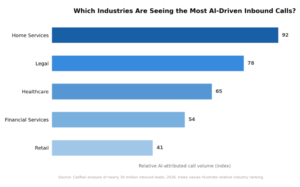
AI – Attributed Leads as a Share of Total Inbound(and Growing Fast)
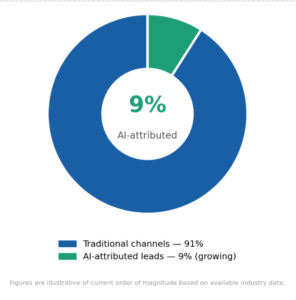
That last limitation matters more than it might first seem. There’s no shortage of confident opinions floating around about AI search right now. What’s been genuinely missing is evidence that it’s driving acquisition rather than just generating impressions or citations. This data, sponsored source aside, is a step toward that evidence. It’s a long way from a complete answer, though.
Before You Optimise For AI, Find Out If It’s Already Working for You
A lot of teams are eager to start optimising for AI search immediately. Before any of that spend or effort goes anywhere, a simpler question deserves an answer first: is AI already sending customers to this specific business, right now, today?
Without measurement in place, there’s genuinely no way to know whether growing AI visibility is translating into anything that matters commercially. As AI search becomes a real customer acquisition channel in its own right, it deserves the same measurement discipline already applied to paid search, organic search, referrals, and social, sitting inside the same reporting framework as everything else rather than off in some disconnected silo.
Existing attribution models don’t need replacing wholesale here. They need to evolve as customer behaviour does, the same kind of evolution good performance marketing has always had to keep pace with every time a new channel showed up and disrupted whatever attribution setup came before it. Email did this. Social did this. Mobile did this. AI search isn’t a fundamentally different category of problem; it’s the latest version of a problem this industry has solved before, just with a faster-moving set of platforms and far less consistent referrer data to work with.
Four Ways to Start Tracking AI-Driven Leads Today
This is where the practical work lives, and where most teams are currently behind. A few approaches worth putting in place:
- Call tracking with source-level detail: If a customer mentions discovering a business through ChatGPT, Perplexity, or Gemini during a call, that detail needs to be captured systematically rather than left as an anecdote a receptionist happens to mention in passing. Dynamic number insertion and post-call surveys can both help close this gap.
- Referrer and landing page analysis for AI-driven sessions: Some AI platforms do pass referrer data, even if it’s inconsistent. Reviewing analytics for unusual referral patterns, AI platform domains showing up where they weren’t before, is a reasonable starting point any seo consultant can run today without new tooling.
- Direct questions in lead capture forms: A single extra field asking “how did you hear about us” with an AI platform listed as an explicit option costs nothing to add and starts building a real dataset almost immediately.
- Treating this as part of standard reporting, not a special project: AI-attributed leads should sit in the same dashboard as every other channel a client already reviews monthly, rather than getting pulled out into a separate, easily ignored report nobody reads.
A genuinely useful AI measurement framework also needs to connect to what happens after the lead arrives. This is where conversion rate optimisation services earn their keep, since knowing AI sent someone to a landing page is only half the picture. The next question is whether that page, that form, or that call flow turned the visit into a customer. Tracking the source while ignoring the outcome only tells half the story.
The chart above shows roughly how these four tracking approaches stack up against each other on two things that matter most when deciding where to start: how much setup effort each one takes, and how reliable the data tends to be once it’s running. Lead form questions take the least effort to set up but land in the middle on reliability, since self-reported answers aren’t always accurate. Call tracking and standard reporting integration both take a bit more setup but pay that back with stronger, more dependable data.
How Does This Change the Conversation with Clients
For anyone working as an seo consultant or SEO strategist, this shift changes the actual conversation with clients. The first wave of AI search advice focused almost entirely on visibility: can people find us, are we being cited, do we show up in the AI Overview? The next wave is going to focus on proving business impact, on answering “how many real leads did this generate” rather than “are we visible.”
That’s a genuinely different deliverable. SEO audit services increasingly need a measurement and attribution component alongside the usual technical and content checks, since a technically flawless site that nobody can prove is generating AI-driven leads becomes a much harder sell to a client watching budget closely. Content marketing strategy also has to think beyond rankings, toward the kind of content that earns a genuine recommendation from an AI assistant, since that recommendation now counts as a measurable, trackable event rather than an abstract goodwill metric.
Businesses that start measuring this now, even imperfectly, will be meaningfully better positioned to understand where AI fits into their wider marketing mix and where the next dollar of budget should go than the ones still arguing about whether AI search even matters yet.
Conclusion
AI search has moved past the point where visibility alone is a useful goal. The businesses pulling ahead now are the ones treating AI-driven discovery the same way they’d treat any other channel: tracked, attributed, and held to the same standard of proof paid search or organic search has always been held to. Whether that work sits with an in-house team, a dedicated SEO strategist, or gets handed off entirely to outsourced SEO services, the underlying principle doesn’t change. Measure first. Optimise second. And don’t mistake a citation for a customer until the data backs that up.
Techosoft Solutions helps Australian businesses build SEO and online marketing services that don’t stop at visibility. From SEO audit services that include real attribution checks to conversion rate optimisation work that turns AI-driven traffic into actual customers, our team focuses on outcomes a client can see in their pipeline, not just their rankings. Get in touch with Techosoft Solutions to see how we can help your business prove what AI search is doing for you.
FAQs
Can small businesses without a marketing team realistically track AI-driven leads?
Yes, even basic steps help. Adding an “AI assistant” option to a lead form’s “how did you hear about us” field, or asking front-of-house staff to note when a caller mentions ChatGPT or another AI tool, costs nothing and starts building useful data immediately without any new software.
Do all AI platforms send referrer data the same way?
No. Referrer behaviour varies meaningfully between platforms, and some pass almost no identifying data at all. That inconsistency is exactly why call tracking and direct lead-form questions matter as a backup, rather than relying on referrer data alone.
Is it worth paying for a dedicated AI attribution tool, or can existing analytics handle this?
For many businesses, a combination of existing tools (call tracking software, a tweaked lead form, closer attention to referrer patterns in GA4) is enough to start. Dedicated AI attribution platforms can add precision later, but they’re not a prerequisite for getting useful data today.
How long does it typically take to see meaningful AI-attributed lead data?
It depends heavily on traffic volume and industry, since AI-driven leads are still a smaller share of total volume for most businesses. A few months of consistent tracking is usually enough to start seeing patterns worth acting on, rather than treating early numbers as statistically solid.
Should SEO content strategy change before or after measurement is in place?
Measurement first, where possible. Without a baseline, it’s difficult to know whether changes to content or technical SEO are improving AI-driven outcomes or simply coinciding with normal fluctuation in an already-small data sample.
