
A few years back, finding anything online meant opening ten tabs.
You’d search something, skim results, jump between websites, read half of one article, compare it with another, and slowly piece together an answer. It took time, but that’s how people made decisions.
That habit is fading.
Now, people are going straight to ChatGPT and asking what they need. Not browsing. Not exploring endlessly. Just asking.
“Which CRM should I use?”
“How much does app development cost?”
“Best marketing strategy for a small business?”
And they get a straight answer.
No digging. No noise.
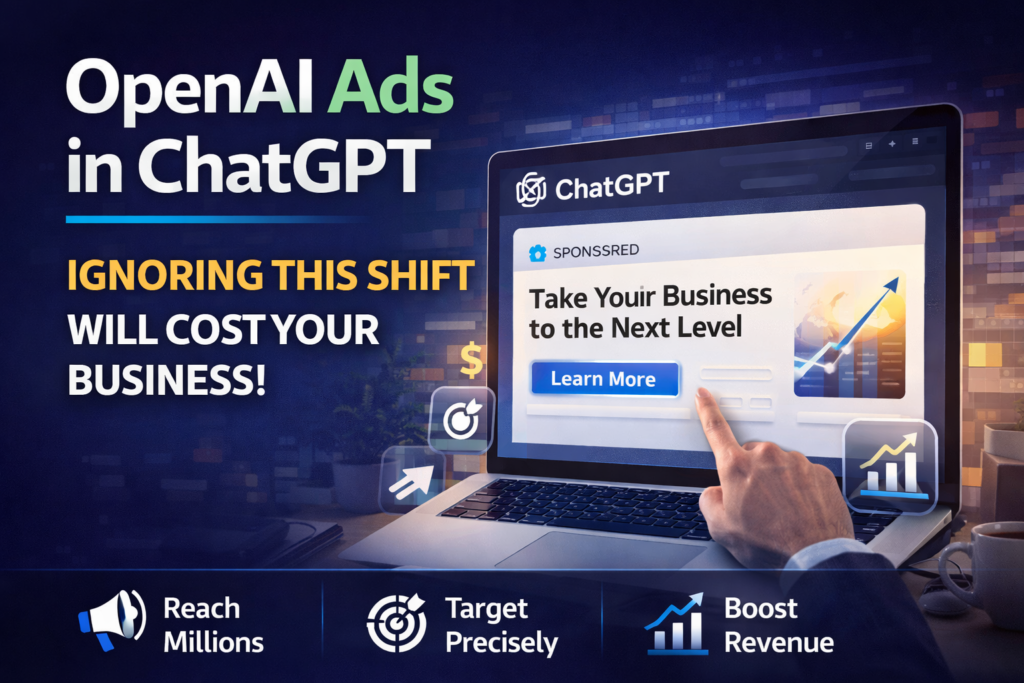
That change looks small from the outside, but it’s quietly reshaping how people choose products and services. And once decisions start happening inside a platform, ads in ChatGPT become inevitable.
That’s exactly where ChatGPT advertising is heading.
Why Ads Showing Up Here Was Always Inevitable
There’s no mystery behind this part.
Running AI at this scale costs serious money. Every response you see isn’t free. Multiply that by millions of users, and you get a system that needs a steady revenue stream to survive long-term.
Subscriptions help, but they only go so far. If a platform wants to stay widely accessible, it needs something more scalable.
Ads are the obvious answer.
This is where ChatGPT monetization starts to make sense, not as an aggressive push, but as a natural evolution of any large-scale AI advertising platform.
But here’s the difference. ChatGPT doesn’t have the same room to experiment the way social media platforms did. It can’t afford to flood the screen with ads or push promotions aggressively.
The whole product is built on trust. Clean answers. Clear thinking. No clutter.
If ads damage that, users won’t stick around.
So what we’re seeing right now is a slow rollout. Careful placement. Clear labeling. Almost conservative, which is rare in digital advertising.
That alone tells you how sensitive this shift is.
The Real Shift Is Not Ads. It’s How People Behave
Most people are focusing on the wrong thing.
They’re watching the ads.
But the real story is how users are behaving.
Search used to be about exploration. You typed something, got a list, and figured things out step by step.
ChatGPT removes that middle layer.
Now people ask, and they expect clarity in one go. This is where conversational search starts replacing traditional browsing.
That changes the mindset completely.
When someone is asking a question inside ChatGPT, they’re usually not just curious. They’re trying to move forward. They want direction.
That’s a different kind of user.
And when ads appear at that moment, they carry more weight because they’re sitting inside a decision, not outside it. This is what defines intent-based advertising.
How Ads Are Being Placed Right Now
At this stage, things are pretty straightforward.
If you’re wondering how ChatGPT ads work, the structure is intentionally simple.
Ads don’t try to blend into answers. They’re not disguised. They’re not hidden between lines.
They appear separately. Clearly marked. Easy to spot.
And more importantly, they show up only when they make sense.
If someone is asking about tools, services, or solutions, there’s a chance a relevant sponsored option appears. If the query is informational, there’s usually nothing.
This keeps the experience clean.
It also keeps users from feeling like they’re being pushed into something.
That balance is important, and honestly, it’s the only way this works.
Why This Feels Different From Normal Advertising
Most online ads are based on guesses.
You clicked something once, and now you see it everywhere. You searched something vaguely related, and the algorithm assumes you’re interested.
Sometimes it works. Most of the time, it just feels repetitive.
ChatGPT removes that guesswork.
The user literally says what they need.
That means ads don’t have to chase attention. They just need to match the moment. This is where AI-driven advertising becomes more precise than traditional systems.
If you compare ChatGPT ads vs Google Ads, the difference is clear. One relies on prediction, the other relies on direct intent.
That sounds simple, but it raises the bar.
If the ad is not relevant, it stands out immediately. There’s no feed to scroll past it. No distraction to hide behind.
It either fits, or it fails.
What This Means for Businesses in Practical Terms
This is where things get real.
For years, digital strategy has been built around getting people to your website. Rankings, ads, traffic, funnels. Everything pointed toward bringing users in.
That model still works, but it’s no longer the only game.
Now there’s a layer where users might not visit multiple websites at all. They get an answer, form an opinion, and move forward.
If your business isn’t part of that answer, you’re invisible at that stage.
That’s the shift.
It’s no longer just about being found. It’s about being included when someone is trying to decide.
This is why ChatGPT ads for businesses and AI ads for lead generation are becoming more relevant. Not because they replace traditional ads, but because they sit closer to the decision point.
Content Is Still the Backbone, Not Ads
There’s a common assumption that ads will dominate this space.
That’s not how it plays out.
AI systems still rely on content to understand what exists, what matters, and what should be surfaced. This is where AI content discovery and GEO optimization come into play.
If your content is clear, useful, and grounded in real problems, it has a chance to show up. If it’s vague or written just for keywords, it gets ignored.
So the focus changes.
Not more content.
Better content.
Content that actually answers something.
Content that sounds like a human explaining a real solution, not a brand trying to impress.
That’s what works here, especially if you want to understand how to get featured in ChatGPT answers.
What Early Movers Are Quietly Doing
Right now, this space is still open.
There’s no heavy competition yet. No fixed rules. No overcrowding.
That means there’s room to get ahead.
The businesses that are paying attention are not rushing to spend on ads. They’re doing something more basic, and more important.
They’re fixing how they present themselves.
They’re making their services clearer.
They’re aligning their messaging with real questions.
They’re simplifying how they explain what they do.
Because they understand where the future of AI advertising is heading.
The Risks That Are Very Real
This is not a perfect system.
If ads become too aggressive, people will push back. That’s guaranteed.
If answers start feeling influenced or biased, trust drops. And once trust drops, everything else follows. This is one of the biggest concerns around AI advertising risks.
There’s also the simple fact that not every conversation is commercial. Many people are just learning or exploring.
That limits how far ads can go in this environment.
Which is actually a good thing.
It keeps the platform from becoming noisy and protects the experience.
Where This Leaves Techosoft
For Techosoft, this isn’t about jumping into ads tomorrow.
It’s about understanding what’s shifting underneath.
People are no longer moving through long decision journeys. They’re getting answers faster and acting sooner.
That means your positioning has to be sharper.
What you do. Who you help. How you solve problems. All of it needs to be clear, direct, and easy to understand.
Because if it’s not, it won’t show up when it matters in this new AI-driven customer journey.
What’s Changing, Quietly but Clearly
People are tired of digging.
They don’t want ten tabs. They don’t want to compare endlessly. They don’t want to decode marketing language.
They want clarity.
And ChatGPT is built for that.
Ads are just being added into that clarity, carefully, step by step.
The real shift is not in how ads look.
It’s where decisions are being made.
And that place is slowly moving from search results to conversations, shaping the future of search and AI-driven marketing.