
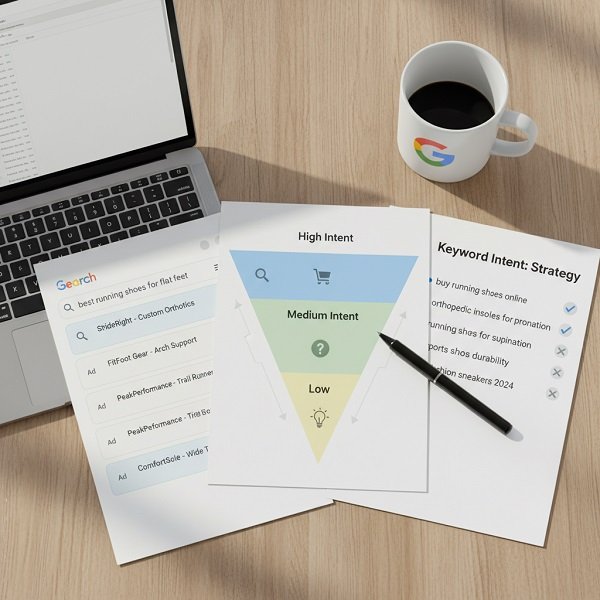
If your Google Ads strategy still begins and ends with keyword lists, you are working with an outdated model.
Most marketing teams still organise campaigns by match type, search term buckets, and cost-per-click targets. It feels structured. It feels measurable. It feels safe.
But Google’s advertising system no longer operates on literal keyword matching alone. The auction is now triggered by inferred intent. That difference is not cosmetic. It changes eligibility, scale, data strategy, and how return on investment should be evaluated.
For leadership teams across Australia, this shift affects revenue forecasting and competitive positioning more than most realise.
The Logic Behind Google Ads Has Changed
Most executive reports still show keyword performance tables.
Cost per click.
Cost per acquisition.
Top converting search terms.
Yet Google no longer optimises campaigns around keywords alone.
It optimises around interpreted intent.
That is a structural shift.
If your internal conversations still centre on keyword control, you are evaluating growth through a legacy lens while the platform operates on probabilistic modelling.
This is not theoretical. It is already influencing which businesses appear in high-value search moments and which do not.
How the Google Ads Auction Works Today
When someone searches, advertisers compete in a real-time bidding environment known as the Google Ads auction.
Historically, eligibility to enter that auction was largely determined by keyword match.
If the search term matched your keyword, you entered the auction.
Today, eligibility is influenced by machine learning models that evaluate commercial intent.
Google’s AI assesses:
- The meaning of the query
- The broader search session
- User behaviour patterns
- Device context
- Historical engagement signals
- Conversion data across similar users
In simple terms, ads are shown because Google believes the user is likely to need your solution, not simply because they typed your keyword.
Example.
A manufacturing director searches:
“How to reduce stock errors after scaling operations.”
That query does not contain “ERP software” or “inventory management system”.
Yet Google detects expansion, operational friction, and commercial relevance. Ads for supply chain software may appear.
The system is matching your offering to a business problem state.
This is how Google Ads AI works in 2026.
The platform no longer relies only on keyword matching. Instead, it uses AI to interpret what a user is trying to achieve. Keywords still matter, but they are now just one signal within a broader intent model.
In many cases, Google determines ad eligibility based on inferred business need rather than exact search terms. Read more about this shift in the recent Search Engine Land article.
Why Intent-Based Advertising Reshapes ROI
The shift to intent-based advertising changes how return on investment must be measured.
Under a keyword model, optimisation focused on:
- Lowest cost per click
- Lowest cost per lead
- Tight keyword control
Under an intent model, optimisation should focus on:
- Revenue contribution by intent stage
- Lead quality by behavioural signal
- Lifetime value alignment
- Pipeline acceleration
Here is the practical difference.
Imagine broad match traffic increases cost per click by 20 percent.
However, leads generated from exploratory intent convert into deals that are 40% larger in value.
If leadership evaluates performance only by CPA, this traffic may be cut.
If leadership evaluates performance by revenue efficiency, it becomes a growth lever.
Intent-based optimisation requires revenue-weighted decision-making, not volume-based metrics.
To improve Google Ads ROI under this model, organisations must connect advertising platforms to CRM systems and import revenue values back into bidding algorithms.
Without revenue signals, automation optimises for cheap conversions, not profitable ones.
What Google Ads Automation Means for Executives
Google Ads automation is not about convenience. It is about control shifting to learning systems.
Campaign types such as Performance Max rely on:
- Broad signal inputs
- Asset diversity
- Conversion feedback loops
- Audience modelling
This creates two realities.
First, a strong data infrastructure compounds performance.
Second, weak signal quality compounds inefficiency.
Signal quality refers to the conversion data and behavioural inputs Google uses to train its bidding systems.
If you only track form submissions, the system cannot differentiate between high-value enterprise leads and low-value enquiries.
If you track qualified opportunity stages or revenue milestones, bidding becomes smarter over time.
For C-suite leaders, this turns data governance into a competitive advantage.
Operational Gaps Holding Businesses Back
Many Australian businesses understand that Google Ads automation exists. Few have structured operations to benefit from it.
1. Long Sales Cycles
B2B and enterprise organisations often operate with 90 to 180-day sales cycles.
If Google Ads is optimised towards early-stage leads only, the system lacks visibility into which leads close.
Solution:
- Import CRM pipeline stages into Google Ads
- Optimise towards sales-qualified leads instead of form fills
- Extend attribution windows to reflect real buying timelines
This aligns automation with commercial reality.
2. Low Conversion Volume
AI-driven bidding requires sufficient data.
Smaller advertisers often struggle to reach minimum learning thresholds.
Solution:
- Consolidate fragmented campaigns
- Focus on fewer high-value conversion events
- Prioritise intent-rich campaigns before expanding automation
Scale follows signal clarity.
3. Misaligned Performance Expectations
High-funnel exploratory searches will not convert at the same rate as brand searches.
Expecting identical returns on ad spend across funnel stages leads to premature budget cuts.
Instead:
- Define different success metrics by intent stage
- Measure assisted conversions
- Track engagement depth alongside revenue
Intent-based systems reward patience and structured evaluation.
A Practical Roadmap for Leadership Teams
You do not need a full rebuild.
You need disciplined progression.
Step 1: Audit Conversion Infrastructure
Within two weeks, confirm:
- Revenue values are tracked
- CRM integration is functioning
- Qualified outcomes are defined
Without this, intent-based optimisation is constrained.
Step 2: Reorganise One Campaign Around Buyer State
Group keywords and assets by:
- Problem awareness
- Solution comparison
- Purchase readiness
Monitor performance over 30 to 60 days before expanding.
Step 3: Upgrade One Landing Page
Rewrite content to answer why the solution matters in context.
Address Australian regulatory, operational, or market-specific realities where relevant.
Intent alignment improves both eligibility and conversion rates.
Step 4: Align Reporting With Revenue
Move executive dashboards beyond keyword metrics.
Include:
- Revenue per conversion
- Lead-to-opportunity ratio
- Pipeline velocity from paid search
This changes how marketing is evaluated at the board level.
The Competitive Consequence of Ignoring Intent
Intent-based systems reward historical data strength.
Brands that provide consistent high-quality conversion signals gain algorithmic confidence.
Confidence increases eligibility.
Eligibility increases reach.
Reach increases data.
This compounds over time.
Businesses that delay adaptation face rising acquisition costs and shrinking visibility in exploratory search environments.
The shift is gradual. The consequences are not.
Where Techosoft Adds Strategic Value
Many organisations attempt to optimise Google Ads through surface-level adjustments.
Techosoft approaches it structurally.
We help Australian businesses:
- Re-architect campaigns around commercial intent
- Integrate CRM and revenue data into Google Ads automation
- Redesign landing experiences aligned to buyer state
- Build executive reporting frameworks tied to profit, not clicks
Intent-based advertising is not a feature update. It is a system change.
If your leadership team is reassessing how paid search contributes to revenue in an AI-driven environment, Techosoft can help redesign the underlying strategy and infrastructure to optimise results.
FAQs
1. What is intent-based advertising in Google Ads?
It is a model where ads are matched to inferred user goals rather than exact search phrases.
2. Are keywords still important in 2026?
Yes, but they act as signals within broader machine learning systems.
3. How does Google Ads AI determine intent?
It evaluates query meaning, user behaviour, historical data, and conversion feedback to predict commercial need.
4. Does broad match improve Google Ads ROI?
When paired with strong revenue signals, a broad match can expand high-value reach.
5. How can Australian businesses improve Google Ads automation performance?
By integrating CRM data, defining qualified conversions, and aligning campaigns to buyer stages.
6. What metrics should executives track instead of keyword CPA?
Revenue per intent stage, lead quality ratios, and pipeline contribution.
7. Is automation suitable for smaller businesses?
Yes, but campaign consolidation and clear conversion signals are essential before scaling.