AI has moved past the phase of novelty.
We’re no longer asking whether it works. That question is already settled. The real shift now is how it fits into everyday business operations, and more importantly, how companies structure their workflows around it.
Most teams today are still using AI in fragments. A chatbot for writing. A tool for coding help. Maybe some automation stitched together across platforms. It works, but it’s disconnected.
What’s emerging now is something more structured.
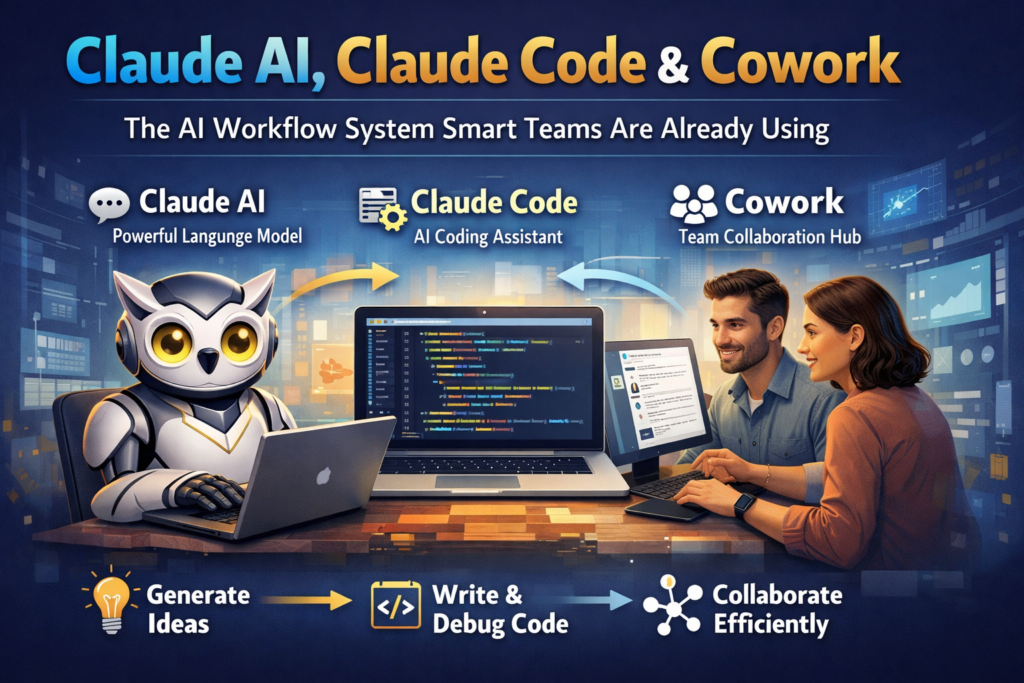
The Claude ecosystem represents that shift. Not as three random tools, but as a layered system designed to support how work actually happens, from thinking, to building, to running operations.
For companies like Techosoft, this is not just another toolset. It’s a way to reduce friction across teams, speed up execution, and create workflows that scale without increasing effort.
Understanding the Claude Ecosystem as a System, Not Just Tools
At a surface level, Claude AI, Claude Code, and Claude Cowork look like separate products. But when you step back, a pattern becomes clear.
Every piece of meaningful work follows a natural flow.
It begins with thinking. Ideas are shaped, problems are defined, and direction is set.
Then comes execution. That direction is turned into something real.
Finally, operations take over. Systems are maintained, tasks are repeated, and processes are scaled.
The Claude ecosystem aligns directly with this flow.
Claude AI handles thinking.
Claude Code handles execution.
Claude Cowork handles operations.
This alignment is what makes the ecosystem powerful. It doesn’t just assist work. It supports the full lifecycle of it.
Claude AI: Bringing Structure to Unclear Thinking
Every project starts with some level of uncertainty. Ideas are rarely fully formed in the beginning. They come as rough notes, scattered inputs, or incomplete thoughts.
Claude AI is built for that stage.
It works best when clarity is missing. When teams are still figuring things out. It takes unstructured input and turns it into something usable, clear documents, refined content, and structured plans.
In a real business setting, this has immediate impact. Product teams can define features faster. Marketing teams can turn research into strategy more efficiently. Leadership can move from ideas to decisions without long delays.
Instead of spending hours trying to organize thoughts, teams can start with direction.
That shift alone changes how quickly work begins.
However, it’s important to understand its role clearly. Claude AI does not execute tasks. It does not interact with systems. It provides clarity, not completion.
And that’s exactly where its value lies.
Claude Code: Turning Plans Into Working Systems
Once direction is clear, the next step is execution. This is where most workflows slow down, especially in development-heavy environments.
Claude Code is designed to remove that bottleneck.
It operates directly within development environments, understanding codebases and making real changes across files. It doesn’t just suggest improvements. It builds, modifies, and tests.
For development teams, this changes the pace of work. Tasks that used to take hours can now be completed faster. Repetitive coding work is reduced, allowing developers to focus on system design and problem-solving.
At Techosoft, this translates into faster delivery cycles and more efficient use of engineering resources.
But with that speed comes responsibility.
Claude Code still requires oversight. It can make mistakes if left unchecked. The goal is not to replace developers, but to enhance how they work.
Used correctly, it becomes a strong execution layer that bridges the gap between planning and delivery.
Claude Cowork: Automating the Work No One Talks About
After thinking and building comes a layer of work that is often overlooked, operations.
This is where teams spend time on repetitive tasks. Updating files, organizing data, generating reports, and managing workflows across tools. These tasks are not complex, but they are constant.
Claude Cowork is built to handle exactly this.
It focuses on automating routine processes across files and applications. Instead of manually repeating the same steps, teams can define workflows that run consistently in the background.
In practical terms, this means less time spent on manual work and more time focused on meaningful tasks.
For Techosoft, this layer improves operational efficiency across departments. It reduces errors, ensures consistency, and removes unnecessary workload from teams.
Unlike coding tools, it does not require technical expertise. And unlike chat-based tools, it doesn’t stop at suggestions. It performs actions.
That’s what makes it valuable.
How These Three Layers Work Together in Real Projects
The real strength of the Claude ecosystem comes from how these layers connect.
A typical workflow might start with Claude AI shaping an idea into a structured plan. That plan then moves into Claude Code, where it is built into a working system. Once deployed, Claude Cowork takes over repetitive tasks, ensuring smooth operations.
This creates a continuous flow.
Ideas become clear faster.
Execution becomes more efficient.
Operations become more consistent.
Instead of working in disconnected steps, teams operate within a connected system.
Over time, this reduces delays, improves output quality, and allows businesses to scale without increasing complexity.
Pros and Limitations Across the Claude Ecosystem
Each layer brings its own strengths, and each comes with boundaries that need to be understood.
Claude AI is easy to adopt, highly flexible, and excellent for structuring ideas. However, it does not execute tasks and depends heavily on the quality of input.
Claude Code offers deep integration with development workflows and significantly speeds up execution. At the same time, it requires review, introduces potential risks if misused, and comes with a learning curve.
Claude Cowork reduces repetitive work and improves operational efficiency, especially for non-technical teams. However, it is still evolving and works best with clearly defined workflows.
Understanding these trade-offs is what allows teams to use each layer effectively.
Quick Comparison: Claude AI vs Claude Code vs Claude Cowork
| Feature | Claude AI | Claude Code | Claude Cowork |
| Role | Thinking & planning | Development & execution | Workflow automation |
| Best For | Content, strategy, research | Coding, debugging, building systems | Operations & non-tech teams |
| Users | All teams | Developers | Low |
| System Access | None | Full codebase | Files & applications |
| Setup Required | No | Moderate | Low |
| Risk Level | Low | Medium | Medium |
| Output | Structured content | Working code | Completed tasks |
Why This Matters for Techosoft and Modern Businesses
The biggest mistake companies make today is treating AI as an add-on.
They use it in isolation, without changing how work actually flows.
The Claude ecosystem offers a different approach. It connects thinking, execution, and operations into a single system. This alignment reduces inefficiencies and creates a more streamlined way of working.
For Techosoft, this means faster project delivery, better resource utilization, and improved consistency across workflows.
More importantly, it creates a foundation that scales.
Instead of increasing effort as work grows, systems handle more of the load.
The Bigger Picture: From Tools to Systems
AI is no longer just about what a tool can do.
It’s about how tools fit together to support real work.
Claude AI, Claude Code, and Claude Cowork represent three layers of that system. Each solves a different problem, and together, they create a more complete workflow.
Businesses that understand this shift early will not just become more productive.
They will operate differently.
And that difference will define how they compete moving forward.