
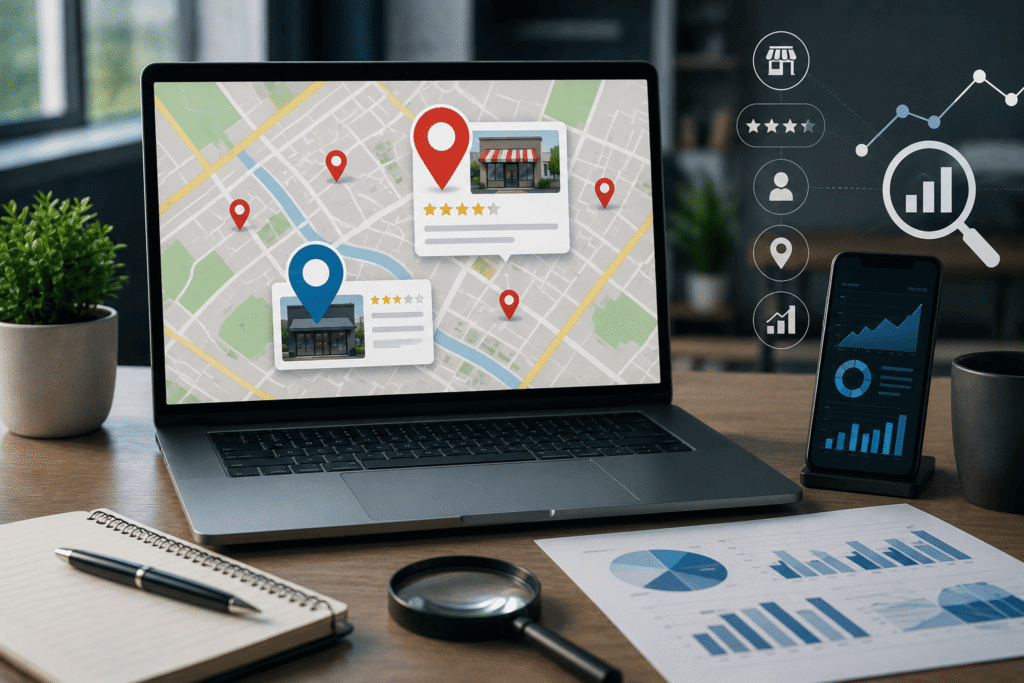
You see this a lot. The profile is genuinely good, filled out properly, photos uploaded, reviews coming in. And there’s still a competitor sitting above you in the map pack with half the effort put in. Annoying, and also pretty common.
Usually, the profile isn’t the problem. The truth is, a flawless profile is just the bare minimum these days. To win, your strategy needs to go deeper, which is exactly why professional local seo services focus on the hidden factors most business owners completely overlook.
Let us cut the fluff and talk about the real reasons your local rankings are stuck in the mud. And more importantly, let us fix it.
Google Looks at the Whole Business, Not Just the Listing
Before Google decides how relevant you are, it first decides what you are. Your name, category, website, citations, reviews, all of it gets stitched together into one entity in Google’s mind. When those pieces line up, Google ranks with confidence. When they don’t, even a flawless profile gets held back, and there’s no warning telling you why.
That’s the part most advice skips. People treat the profile as the finish line. It’s really just one input into something bigger.
1. Citation Inconsistencies Undermine the Profile You Just Optimised
Citations are every mention of your business name, address, and phone number scattered across the web. Directories, review sites, old listings nobody remembers creating. Google checks these against each other constantly, and small mismatches chip away at how confident it feels about your exact location.
It doesn’t take much:
- A directory still showing “Unit 4” while your site says “Suite 4”
- An old phone number sitting on a citation site, untouched for years
- Two versions of the same listing, nobody ever merged
- The business name has the suffix in some places, without it in others
| Citation Problem | Effect on Local Rankings |
| Address formatting mismatches | Weakens geocoding confidence |
| Outdated phone numbers | Creates conflicting business records |
| Unmerged duplicate listings | Splits authority between two profiles |
| Inconsistent business name | Confuses Google’s entity match |
None of this shows up as a warning in your dashboard. The dashboard looks fine. The rest of the web is telling a slightly different story, and Google tends to side with the majority.
2. The Website Doesn’t Back Up What the Profile Claims
A profile lists three suburbs served, specific services, and maybe a delivery radius. The website talks about the business in vague terms with nothing local on it at all. Happens more than you’d think.
Google checks for that alignment. Claim a suburb on the profile with nothing reflecting it on the actual site, and the relevance signal stays thin, however complete the profile looks.
A few things worth checking:
- Service pages that never mention the areas covered
- Nothing touching on local landmarks, events, or community involvement
- Page titles that could belong to a business in any city in the country
- One generic location page trying to do the work of four or five
This gap is one of the more overlooked pieces of local SEO services. Fixing it takes actual content work, not a five-minute edit.
3. Proximity Works Against You No Matter How Good the Profile Is
Here’s the part nobody likes hearing. Distance between the searcher and your address is one of the heaviest local ranking factors, and there’s no way to optimise your way around it directly. A competitor three minutes from a searcher beats one fifteen minutes away, even with a noticeably weaker profile. That’s just how it works.
A strong profile doesn’t cancel that out, but relevance and prominence can occasionally close the gap:
- Real mentions on local blogs, sponsorship pages, community event listings
- Reviews that naturally mention nearby suburbs or landmarks
- Genuine local partnerships rather than generic backlinks bought in bulk
You’re not moving your address. You’re building up how confidently Google ties your business to the area beyond a tight radius.
4. The Wrong Category Can Quietly Cap Visibility From the Start
The primary category isn’t decoration. Paired with your business name, it tells Google what searches you’re even eligible to show up for, before proximity or reviews get weighed at all. Get the category slightly wrong, or run a name that skews narrower than the business is, and you can get filtered out of relevant searches before competition even enters the picture.
A bakery branded heavily around one product, something like “Sourdough & Co,” might struggle for broader bread or pastry searches simply because the name itself sends too narrow a signal. Worth checking if rankings have flatlined and nothing else explains it.
5. Review Momentum Matters More Than Review Count
Fifty reviews from a launch campaign two years back carry less weight today than ten a month, steadily, from a competitor doing it properly. Google treats recent activity as a freshness signal. If you stop generating reviews after that initial push, rankings will steadily erode, even if your total count remains substantially higher.
| Review Pattern | What It Signals to Google |
| Steady monthly reviews | Active, ongoing trust |
| Stopped after the early push | Declining relevance over time |
| Sudden spike, then nothing | Possible manipulation flag |
| Reviews mentioning specific areas | Stronger local relevance |
This is exactly where ongoing Google My Business management services tend to beat a one-off optimisation pass. Consistency matters more than a big number chased once.
6. Auditing the Profile Alone Misses the Bigger Picture
The most common mistake is treating a profile audit as the whole audit. Google doesn’t see a business in separate pieces. Profile data, website structure, citations, reviews, category alignment, it’s all one connected picture feeding the same judgement.
A thorough review examines the synergy between those components. It is not a binary checklist of completed fields.
The Real Takeaway
A fully optimised GMB profile is necessary. It’s just not enough on its own. It’s one piece of a much bigger entity Google keeps evaluating, and the businesses ranking consistently well usually have every piece pulling in the same direction, not one strong profile propping up a weak foundation.
As a trusted local seo expert, Techosoft Solutions works with local businesses and franchises to look past the profile itself, checking citation consistency, local content depth, and the broader signals that decide visibility. The focus stays on fixing what’s genuinely holding rankings back, not re-polishing something already in decent shape.
If rankings have stalled despite a strong profile, it’s worth finding out why before sinking more time into the same fixes. Get in touch for proper local SEO services and see what’s genuinely limiting your visibility.
Frequently Asked Questions
How long does it take to fix local SEO issues beyond Google Business Profile?
Citation cleanup and on-site local content changes typically take four to eight weeks to show movement, slower than profile edits alone since directories take time to re-index and Google needs to re-crawl the updated signals.
Do I need a physical office for local SEO services to work?
Not necessarily. Service area businesses without a public address can still rank well, but they rely more heavily on consistent citations and locally relevant content since they don’t benefit from the same proximity signal a storefront gets.
What’s the difference between a local SEO expert and a general SEO agency?
A local SEO expert focuses specifically on map pack visibility, citation networks, and proximity-related ranking factors, whereas a general SEO agency often treats local search as a smaller add-on to a broader organic strategy.
Can fixing technical issues on my website help local rankings?
Yes. Slow load times, poor mobile performance, or broken location pages weaken the same relevance signals local rankings depend on, even though they sit outside the Google Business Profile itself.
Is it worth running local SEO and national SEO at the same time?
It depends on the business. Franchises and multi-location businesses often need both running in parallel, while a single-location business usually gets more value concentrating its budget on local SEO first.