
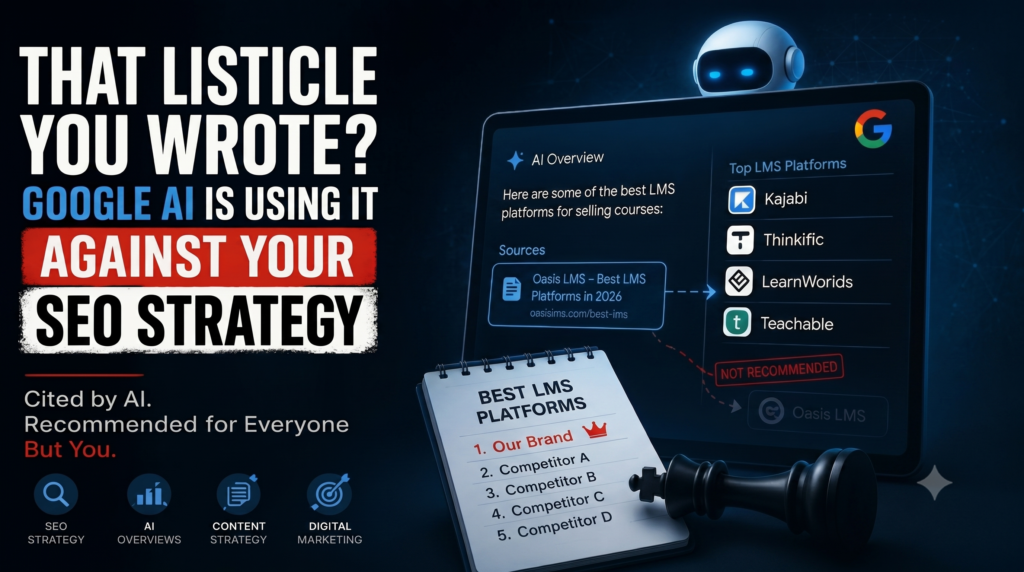
If you have been publishing self-promotional “best” listicles to boost your visibility in AI search, there is something you need to know. Google’s AI Overviews are using your content against you.
Recent research by SEO analyst Lily Ray has uncovered a sobering reality for B2B brands. Google AI Overviews are citing self-promotional “best” listicles while excluding the brands behind them from recommendations 69 percent of the time.
In other words, your carefully crafted “Best SEO Software” or “Top CRM Platforms” article, the one that ranks your own brand first, is being used by Google’s AI as a competitor research tool. The AI extracts your competitive set, ignores your self-ranking, and recommends everyone else.
Let us break down what is happening, why it matters for your digital marketing strategy, and what you need to do about it.
The Numbers Don’t Lie
Ray analysed 100 B2B “best category software” queries in Google AI Overviews across three dates. Here is what the data revealed.
Of the 80 prompts that triggered an AI Overview, self-promotional listicles were cited 323 times. In 224 cases, Google cited a brand’s own page but did not recommend that brand. That is a 69 percent failure rate. Your content gets cited, but your competitors get the recommendation.
Take the query “best LMS for selling courses” as an example. Google cited Oasis LMS’s own listicle but did not recommend Oasis. Instead, it recommended Kajabi, Thinkific, LearnWorlds, and Teachable. All of those were named in the Oasis LMS article.
Similar patterns emerged for help desk, task management, survey, CRM, and SEO software queries. The pattern is consistent. Brands that publish self-ranking “best” lists are inadvertently creating lead generation opportunities for their competitors.
Why This Happens: Citations Are Not Recommendations
Here is the fundamental shift that many SEO professionals and digital marketing agencies are missing.
A citation is not a recommendation.
Your content can appear as a source in an AI answer while helping competitors capture the visibility that matters most. Google’s AI is treating your self-promotional listicle as a credible source of competitive intelligence, not as an endorsement of your brand.
This mirrors what we saw with reviews 18 months ago. Google seems to be treating those listicles as a competition map now, not a credibility signal. The effort you put into that page is being repurposed to benefit your rivals.
Brands that already led their categories, were widely mentioned by third-party sources, and had stronger link profiles were more likely to appear in AI Overview recommendations. If you are not already a category leader, self-promotional listicles won’t help you break through. They will just hand your competitors the spotlight.
The Visibility Decline Is Real
If you have been relying heavily on self-promotional listicles as part of your SEO campaign management, the numbers are not in your favour.
Ray reported organic search declines for many sites that leaned into this strategy. The declines began around January 20 and have continued across dozens of sites she analysed. Many of these sites also scaled other SEO and GEO-focused content formats, including AI-generated articles, comparison pages, and large volumes of “best” pages ranking their own brand first.
The declines accelerated during Google’s May 2026 core update. If your SEO or digital marketing strategy has been built around self-promotional listicles, you are likely feeling the impact right now.
Third-Party Sites Are Winning
While self-promotional listicles are backfiring, third-party review sites and user-generated content platforms are gaining citations.
Forbes, Reddit, and YouTube were among the most-cited domains in AI Overview responses containing “best” queries. Reddit citations, in particular, have increased sharply in recent months.
This does not mean you should abandon content writing altogether. It means you need to rethink how you create and position content. Content that focuses on genuine value rather than self-promotion is more likely to earn citations that actually convert.
What This Means for Your Digital Marketing Strategy
If you are a digital marketing agency helping clients navigate AI search, here is what you need to communicate.
1. Stop Publishing Self-Promotional “Best” Listicles
If you are ranking your own brand first in a “best of” listicle, you are doing more harm than good. Google’s AI is using that content to recommend your competitors. This applies whether you are helping local businesses, e-commerce stores, or large enterprises.
2. Focus on Third-Party Validation
Google is increasingly relying on third-party sources for recommendations. If you want to be recommended, you need to be mentioned by credible third parties. This means investing in genuine brand reputation and link building that comes from earned media, not manufactured self-promotion.
3. Create Content That Serves, Not Sells
Instead of writing “Best X” articles that rank yourself first, create content that genuinely helps users make informed decisions. Content syndication, inbound marketing, and quality writing that prioritises user value over self-promotion will serve you better in the long run.
4. Optimise for AI Overviews the Right Way
Technical SEO, on-page SEO, and off-page SEO all matter, but the rules have changed. AI Overview optimisation now means answer-first formatting that directly addresses user queries, structured data that helps AI understand your content, and long-tail question mapping that anticipates what users are asking.
5. Don’t Ignore the Legal Risks
There is also a legal risk that Australian businesses cannot ignore. Under the Australian Consumer Law, enforced by the ACCC, it is illegal to create or arrange for misleading reviews. If you do not clearly disclose your commercial connection, publishing self-promotional content that appears to be an independent review could be seen as misleading conduct. Honesty is not just good ethics; it is the law.
What Works Now
So what should your SEO strategy look like in this new AI-driven landscape?
Earned media matters more than ever. Third-party citations from reputable sources carry more weight than self-promotional content. If you are a local SEO expert, this means focusing on genuine customer reviews and local citations rather than trying to manufacture authority.
User-generated content is gold. Reddit and other UGC platforms are being heavily cited. Encourage authentic user reviews, case studies, and community discussions about your brand.
Diversify your content formats. Do not put all your eggs in the listicle basket. Invest in video content, podcasts, and other formats that build genuine authority.
Consider multilingual and international SEO. If you are targeting global audiences, earning citations across different markets and languages can help you build a more robust online presence.
The Bottom Line
Google’s AI Overviews have changed the game. Self-promotional listicles are no longer a shortcut to visibility. They are a liability that helps your competitors win.
If you are a digital marketing consultant or SEO professional, this is your opportunity to guide clients toward strategies that work in the AI era. The brands that succeed will be those that earn genuine third-party validation, create value-driven content, and optimise for AI Overviews the right way.
Citations are not recommendations. And in 2026, that distinction could make or break your online marketing strategy.
About Techosoft Solutions
At Techosoft Solutions, we help businesses navigate exactly these kinds of shifts. As a Sydney-based digital marketing agency, we combine AI-driven insights with genuine human expertise to build SEO strategies that work in today’s search landscape. Whether you need technical SEO, e-commerce SEO, local SEO, or a complete digital marketing overhaul, our digital marketing strategy focuses on what delivers real results, not shortcuts that backfire. We believe in earning authority through genuine value, not gaming the system with self-promotional fluff. Reach out to see how we can help your brand earn recommendations with our result-driven SEO strategy.
