

When Great Content Quietly Stops Working
You publish a blog. It earns traffic, attracts backlinks, generates enquiries, and becomes one of your best-performing pages. Months later, nothing seems to have changed. The content is still accurate, the page is indexed, and your website is technically sound.
Yet organic traffic begins to slip.
At first, the decline is almost invisible. A few keywords move down by a position or two. Click-through rates fall slightly. Competitors begin appearing above your page for search terms you once dominated. Before long, enquiries start dropping, and you’re left wondering what happened.
This isn’t always the result of a Google algorithm update. In many cases, it’s content decay.
Content rarely loses visibility overnight. It fades gradually as search intent evolves, competitors improve their content, industry information becomes outdated, or your website grows without maintaining older pages. By the time rankings decline noticeably, the warning signs have often been present for weeks or even months.
Recognising these early signals is what separates successful websites from those that constantly struggle to regain lost traffic.
A strong content marketing strategy doesn’t end when content is published. It includes ongoing monitoring, timely updates, and continuous improvement. Combined with effective SEO content writing, this approach helps your content stay relevant long after it goes live.
What Is Content Decay?
Content decay is the gradual decline in a page’s ability to generate organic visibility, clicks, engagement, or conversions over time.
Unlike a sudden traffic drop caused by a technical issue or manual penalty, content decay happens slowly. It often begins before you notice any meaningful ranking changes.
Think of it like maintaining a garden. Healthy plants don’t stop growing overnight. Without regular care, weeds appear, nutrients disappear, and healthy plants slowly lose their strength. Your website works much the same way.
Several factors contribute to content decay, including:
| Cause | How It Affects Rankings |
| Outdated information | Reduces relevance and trust |
| Changing search intent | Your content no longer answers what users want |
| Stronger competitors | Competitors publish more comprehensive resources |
| Poor internal linking | Google struggles to understand page importance |
| New SERP features | AI summaries, videos, and snippets reduce clicks |
| Industry changes | Statistics, tools, and best practices become obsolete |
The key takeaway is simple.
Content isn’t static. Search is constantly evolving, and your pages need to evolve with it.
Why Waiting for Rankings to Drop Is Already Too Late
Many businesses only update content after noticing a significant decline in traffic.
By then, recovery becomes much harder.
Search engines evaluate freshness, usefulness, authority, and user satisfaction continuously. If competing websites consistently publish updated, more comprehensive content while yours remains unchanged, your page gradually becomes less competitive.
This creates a cycle:
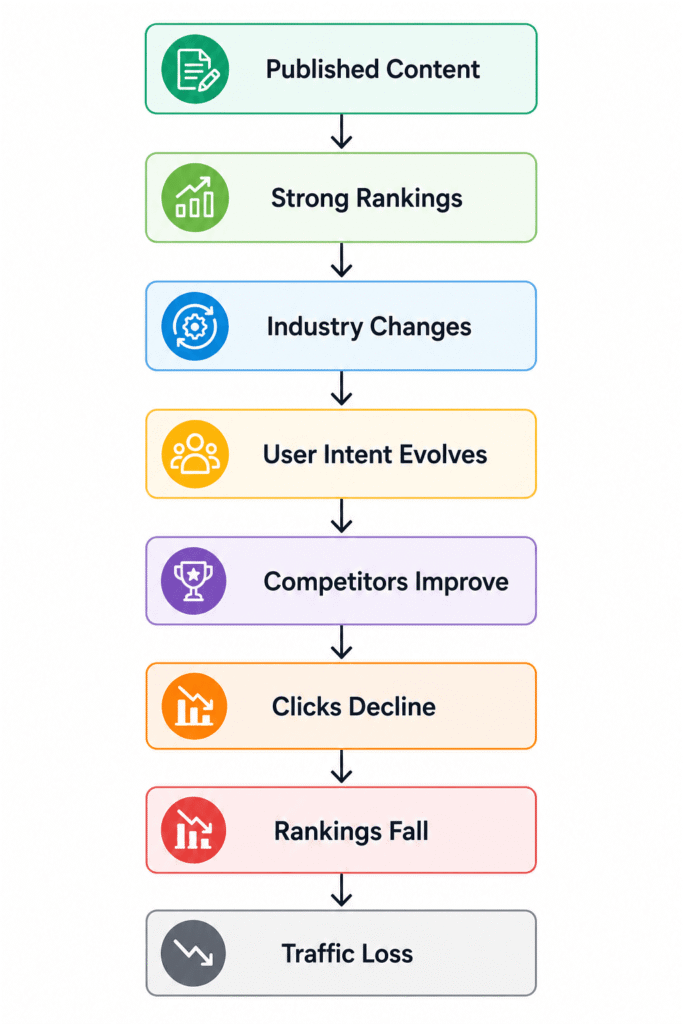
The smartest businesses interrupt this cycle before reaching the final stages.
Regular audits, strategic updates, and professional content writing services help identify hidden weaknesses long before they become costly.
The 10 Types of Content Decay Every Business Should Recognise
Not every decline has the same cause.
Understanding the type of decay affecting a page makes it much easier to choose the right solution.
1. Freshness Decay
This is the most recognisable type of content decay.
Your page still answers the topic well, but the examples, statistics, screenshots, research, or recommendations are no longer current.
Common signs
- Old publication dates
- Broken references
- Outdated statistics
- Screenshots of discontinued software
- Mention of obsolete industry practices
Example
A blog discussing SEO trends from 2023 is unlikely to satisfy someone searching for the latest strategies in 2026, even if much of the advice remains accurate.
How to fix it
- Update statistics
- Replace outdated examples
- Add recent industry developments
- Refresh screenshots
- Expand sections based on new search trends
2. Intent Decay
Sometimes your content remains accurate, but users are searching with different expectations than they did when the article was published.
Search intent changes surprisingly often. For example, people searching for “content marketing strategy” today may expect:
- AI search optimisation
- First-party data strategies
- Zero-click search insights
- Content refresh workflows
A guide written several years ago may focus only on blogging and social media.
Both are correct. Only one fully satisfies today’s search intent.
Warning signs
- Declining click-through rates
- Lower engagement
- Higher bounce rates
- Stable rankings but falling traffic
3. Competitive Decay
Your competitors haven’t stood still.
While your article remains unchanged, others have:
- Added expert interviews
- Included original research
- Improved readability
- Embedded videos
- Published case studies
- Expanded topical depth
Google often rewards the page offering the most complete experience rather than the one published first.
If several competitors continue improving while your page remains static, gradual ranking loss becomes almost inevitable.
4. Authority Decay
Authority isn’t permanent.
A page that once earned backlinks and industry recognition can gradually lose influence if:
- New authoritative resources emerge
- Existing backlinks disappear
- Your site publishes fewer supporting articles
- Competitors strengthen topical authority
This type of decay is particularly common in highly competitive industries such as finance, healthcare, technology, and digital marketing.
Strengthening topical clusters and maintaining a consistent content marketing strategy helps reinforce authority over time.
5. Internal Linking Decay
As websites grow, older articles often become isolated.
New pages are published every month, but older resources receive fewer internal links. Eventually, Google treats them as less significant within your site’s overall structure.
Quick audit
Ask yourself:
- Does this page receive links from newer blogs?
- Is it connected to relevant service pages?
- Can users naturally discover it while browsing related topics?
For businesses investing in SEO content writing, internal linking should never be treated as an afterthought. It plays a significant role in helping both users and search engines understand how your content connects.
6. Technical Decay
Not every decline in performance is caused by the content itself. Sometimes the page is still valuable, but technical issues prevent it from performing at its full potential.
Even minor technical problems can gradually affect visibility if they remain unresolved.
Common warning signs
- Pages taking longer to load than before
- Broken images or videos
- Internal links returning 404 errors
- Duplicate title tags or meta descriptions
- Crawl or indexing issues
- Mobile usability problems
These issues often go unnoticed because the page still appears online. However, search engines consider page experience alongside relevance when determining rankings.
How to fix it
Conduct regular technical audits alongside your content reviews. A technically healthy page gives your content the best chance of competing in search results.
7. Trust Signal Decay
Trust isn’t built once and forgotten.
As industries evolve, readers expect current evidence, updated references, and credible sources. A guide written several years ago may still be factually correct, but without recent supporting information, it can lose credibility.
Examples of trust signals
- Recent industry statistics
- Updated references
- Expert insights
- Author credentials
- Accurate publication and review dates
- Original examples
Refreshing these elements reassures both readers and search engines that the information remains dependable.
8. Multimedia Decay
Reader expectations have changed dramatically.
Ten years ago, long blocks of text were common. Today, users expect a richer experience. Pages that include helpful visuals often keep visitors engaged for longer.
Consider adding:
- Comparison tables
- Process diagrams
- Original illustrations
- Infographics
- Checklists
- Short explainer videos
- Interactive tools where appropriate
Visual elements improve readability while making complex topics easier to understand.
9. SERP Feature Decay
Search results have changed.
Users no longer see only ten blue links. Today’s search results may include:
- AI-generated summaries
- Featured snippets
- People Also Ask
- Videos
- Images
- Local packs
- Discussions and forums
A page that ranked well several years ago may receive fewer clicks simply because these new search features occupy more space.
How to adapt
Structure your content so it answers questions clearly.
Use:
- Descriptive headings
- Concise definitions
- Bullet lists
- Tables
- Step-by-step explanations
Well-structured content is more likely to appear in enhanced search experiences.
10. Conversion Decay
Sometimes rankings remain stable while enquiries decline.
This is conversion decay. Visitors continue arriving, but fewer take action.
Possible causes include:
- Outdated calls to action
- Weak value propositions
- Missing trust signals
- Slow enquiry forms
- Irrelevant offers
Your analytics may show healthy traffic while business results continue falling.
That is why content performance should always be measured beyond rankings alone.
Content Decay Diagnosis Matrix
| Type of Decay | Early Warning Sign | Primary Cause | Recommended Action |
| Freshness | Old data | Outdated information | Refresh statistics and examples |
| Intent | Falling CTR | Search behaviour changed | Rewrite headings and introduction |
| Competitive | Gradual ranking decline | Better competing pages | Expand topical coverage |
| Authority | Lost visibility | Weaker topical authority | Publish supporting content |
| Internal Linking | Reduced crawl frequency | Poor site structure | Add contextual internal links |
| Technical | Indexing issues | Website problems | Perform a technical SEO audit |
| Trust | Lower engagement | Outdated references | Update sources and author information |
| Multimedia | Short sessions | Poor user experience | Add visual content |
| SERP Feature | Lower organic clicks | Search page changes | Optimise for snippets and AI summaries |
| Conversion | Lower enquiries | Weak user journey | Improve CTAs and conversion paths |
A Simple Framework to Prevent Content Decay
Think of content maintenance as a continuous cycle rather than a one-time project.
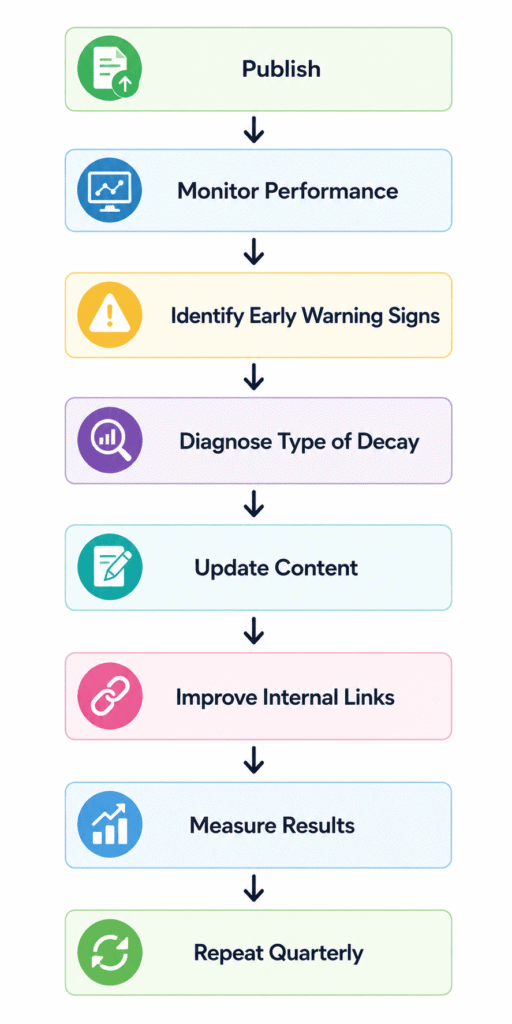
Businesses that follow this cycle consistently are far less likely to experience sudden traffic declines.
Common Mistakes That Accelerate Content Decay
Many businesses unknowingly make content decay worse.
Avoid these common mistakes:
- Updating only the publication date without improving the content
- Ignoring pages that still receive moderate traffic
- Publishing new articles instead of improving existing high-value pages
- Removing useful content during redesigns
- Forgetting to update internal links after publishing new blogs
- Measuring success using rankings alone
A proactive approach almost always outperforms reactive fixes.
Key Takeaways
- Content decay begins long before rankings noticeably decline.
- Different types of decay require different recovery strategies.
- Regular audits help identify problems early.
- Strong SEO content writing focuses on long-term relevance, not just initial rankings.
- Effective content marketing includes ongoing optimisation, not simply publishing new articles.
- Businesses investing in professional content writing services are better positioned to maintain visibility as search behaviour evolves.
Keep Your Content Working Harder with Techosoft Solutions
Publishing great content is only the beginning. Sustained organic growth depends on keeping your website relevant, authoritative, and aligned with changing search behaviour.
At Techosoft Solutions, we provide content writing services backed by SEO strategy, technical expertise, and ongoing content optimisation. From identifying hidden content decay to refreshing high-performing pages and building topic clusters, our team helps businesses protect existing rankings while uncovering new growth opportunities.
Whether you’re looking to strengthen your blog, improve service pages, or build a long-term content strategy, our experienced writers and SEO specialists create content that delivers lasting value for both users and search engines.
Ready to Future-Proof Your Content?
Don’t wait until your rankings disappear before taking action.
Review your existing content, identify early signs of decay, and make strategic improvements before traffic starts slipping. If you need expert support, Techosoft Solutions can help you create, optimise, and maintain content that continues delivering results long after it’s published.
Get in touch today and build a content strategy designed for long-term organic growth.
Frequently Asked Questions
1. How often should evergreen content be reviewed?
Evergreen content should ideally be reviewed every three to six months. High-performing pages may require more frequent updates, especially in industries where information changes quickly.
2. Can content decay affect local SEO?
Yes. Outdated location pages, inaccurate business information, or neglected local content can reduce visibility in local search results and impact customer enquiries.
3. Is it better to update an existing page or publish a new one?
If the existing page already has authority, backlinks, and rankings, updating it is usually more effective than creating a new page targeting the same topic.
4. What tools can help identify content decay?
Platforms such as Google Search Console, Google Analytics, and SEO monitoring tools can reveal declining impressions, clicks, rankings, and engagement trends that indicate content decay.
5. Does adding new sections help improve rankings?
Adding genuinely useful information that addresses emerging user questions can strengthen topical relevance and improve the overall value of a page.
6. Should every piece of content be updated?
Not always. Focus first on pages that drive meaningful traffic, generate conversions, or support important business goals. Prioritising these pages delivers the greatest return on your optimisation efforts.
